The Rebuild Calculus: When Overhauling Critical Components Outperforms Buying New Iron
The instinct to replace rather than repair is deeply embedded in American industrial culture. When a critical machine component fails—a transmission, a hydraulic pump assembly, a complete drivetrain—the conversation in the maintenance bay often turns immediately to new equipment quotes. That instinct is not without logic; new machines carry warranties, known performance specifications, and the psychological comfort of a clean slate. But it is also frequently the more expensive choice, and in an era of constrained capital budgets and extended equipment lead times, the rebuild case deserves a rigorous hearing.
This article presents a practical financial framework for evaluating selective component overhauls against full equipment replacement—and examines how advances in remanufacturing technology are reshaping the economics of that decision.
The Core Question: What Are You Actually Replacing?
Full equipment replacement decisions are often made as though the entire machine has failed. In practice, major component failures rarely indicate universal mechanical deterioration. A transmission failure in an otherwise sound piece of construction equipment does not mean the machine's frame, hydraulic circuits, electrical systems, and operator interface have simultaneously reached end of life. Yet the replacement decision treats them as though they have—discarding residual value across every functional system in the machine.
The first analytical step in any rebuild-versus-replace evaluation is a rigorous condition assessment of all major systems independent of the failed component. This assessment should be performed by a qualified independent technician—not the equipment dealer whose financial interest aligns with new equipment sales—and should document the estimated remaining service life of each major assembly.
When that assessment reveals that a machine with a failed transmission retains strong residual value in its hydraulic system, structural components, and powertrain, the economic case for targeted rebuild strengthens considerably.
Building the Cost Model
A credible rebuild-versus-replace financial model requires capturing costs that are frequently omitted from informal comparisons.
New Equipment Acquisition Costs
The invoice price of a new machine is only the starting point. A complete acquisition cost model should incorporate:
- Delivery and commissioning costs, which for heavy equipment can represent two to five percent of purchase price.
- Operator familiarization and retraining, particularly when the replacement machine differs in controls, interface, or operating characteristics from the unit being replaced.
- Financing costs over the ownership period, which on a capital-intensive equipment purchase can represent a material percentage of total cost of ownership.
- Insurance adjustments associated with the new asset.
- Residual value of the replaced unit, which represents a cost offset but is often understated in informal comparisons. A machine with a failed transmission but sound remaining systems retains meaningful salvage or trade-in value.
Component Rebuild Costs
On the rebuild side, cost modeling must be equally comprehensive:
- Parts and labor for the overhaul, including any ancillary components typically replaced as part of a thorough rebuild (seals, bearings, wear surfaces).
- Downtime costs during the rebuild period, including rental equipment or production schedule adjustments required to cover the machine's absence.
- Warranty coverage on rebuilt components—a factor that has improved substantially as remanufacturing quality standards have advanced.
- Projected remaining service life following the rebuild, which determines the time horizon over which rebuild costs are amortized.
The downtime variable deserves particular emphasis. A transmission rebuild on a complex piece of heavy equipment may require two to four weeks in a qualified shop. If the machine is on the critical path of a production or construction schedule, that downtime carries real cost. Conversely, new equipment lead times in the current market environment frequently extend to three to six months for in-demand models—a reality that can flip the downtime calculus entirely in favor of the rebuild.
Remanufacturing: Changing the Economics
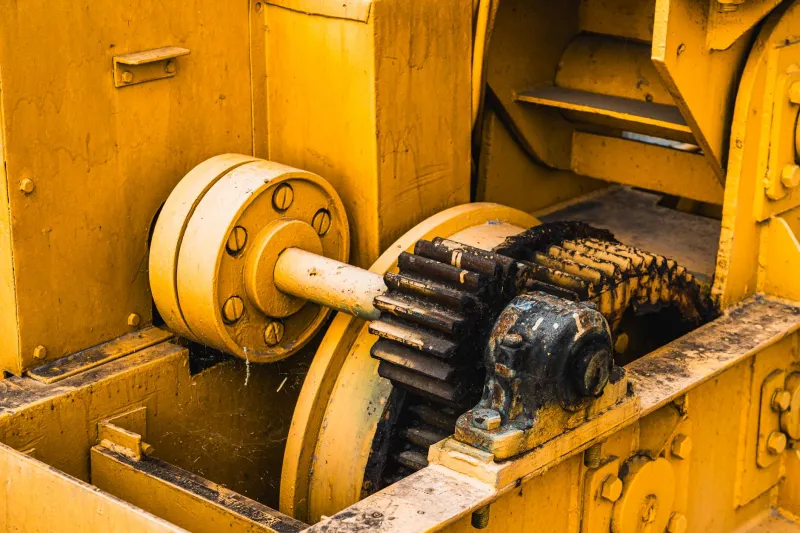
The rebuild option has been strengthened considerably by the maturation of the heavy equipment remanufacturing industry. Remanufactured components—transmissions, hydraulic pump and motor assemblies, torque converters, final drives—are now available from established suppliers with documented quality standards, measurable performance specifications, and warranty coverage that frequently matches or approaches OEM new-part terms.
The economic advantage of remanufactured components over new OEM replacements is substantial. Remanufactured transmissions for common heavy equipment platforms typically price at forty to sixty percent of new OEM cost. Hydraulic pump assemblies follow similar patterns. For buyers who previously dismissed rebuild options on quality or reliability grounds, the current state of the remanufacturing supply chain warrants a reassessment.
Exchange programs—in which a core unit is surrendered and a remanufactured replacement is installed—further reduce downtime by eliminating the waiting period associated with sending a unit out for individual rebuild. Core exchange availability has expanded significantly across major equipment categories and component types.
Residual Value Retention: The Often-Ignored Factor
One of the most consistently underweighted factors in rebuild-versus-replace analysis is the residual value impact of strategic rebuilds on the existing asset. A machine that receives a remanufactured transmission, properly documented and warranted, enters a different residual value category than one carrying a known major component failure. That improvement in asset value has direct implications for financing, insurance, and eventual disposition—none of which appear on the repair invoice but all of which affect total cost of ownership.
Fleet managers who maintain disciplined rebuild programs on high-value assets report that the combination of extended service life and preserved residual value frequently produces total cost of ownership outcomes that compare favorably with replacement cycles driven by component failure alone.
Decision Framework: A Practical Checklist
For procurement and maintenance managers evaluating a specific rebuild-versus-replace decision, the following questions structure the analysis:
- What is the condition of all major systems independent of the failed component? Has an independent assessment been completed?
- What is the current residual or trade-in value of the machine with the failed component?
- What is the fully loaded cost of the rebuild, including downtime?
- What is the fully loaded cost of replacement, including lead time, commissioning, and financing?
- What is the realistic remaining service life post-rebuild, and how does it compare to the expected service life of a replacement unit?
- Is remanufactured component availability and warranty coverage adequate for the application?
- Does the existing machine, post-rebuild, meet current operational requirements—or does the application genuinely require capabilities the current machine cannot provide?
That final question matters. When a production requirement has evolved beyond what the existing machine can deliver regardless of its mechanical condition, replacement may be the correct answer on operational grounds independent of cost. But when the machine's capabilities remain aligned with the application, the rebuild calculus often favors the overhaul—and the numbers, properly assembled, make that case without ambiguity.